THE BEAUTY MUST COME FROM WITHIN

Critique: THE BEAUTY MUST COME FROM WITHIN
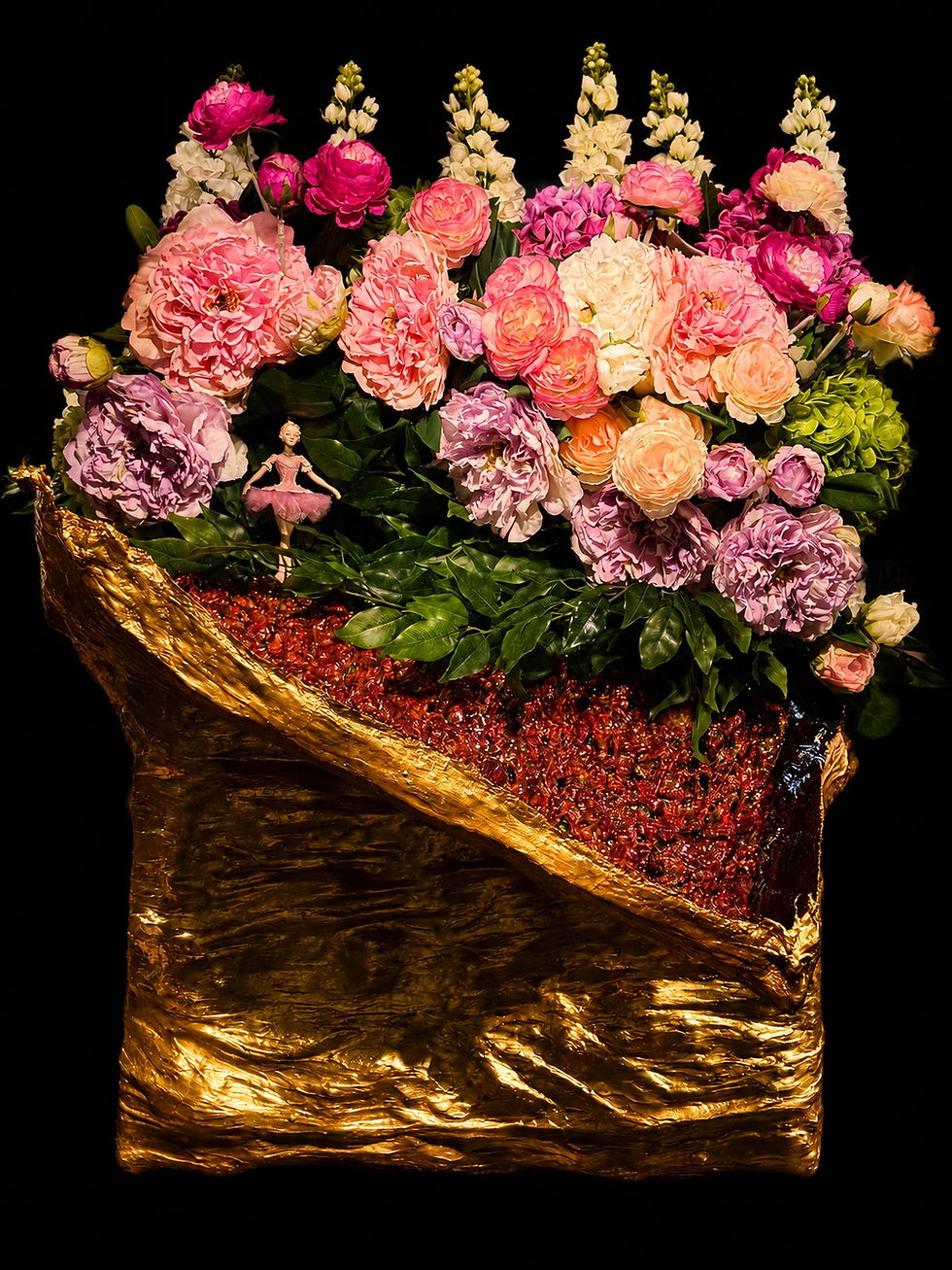
The Beauty Must Come From Within operates through a seductive contradiction. At first glance, it is sumptuous, almost indecently beautiful: an abundance of peonies, roses and towering blossoms erupts from a heavily gilded structure. But the longer the work is considered, the less trustworthy that beauty becomes. The gold is not precious. It is a disguise.
The lower portion of the work is especially effective because the gold surface feels simultaneously luxurious and cheap. Its wrinkles, ridges and unevenness evoke gilding, foil, theatrical scenery, even gift wrapping. It promises value while visibly struggling to maintain the illusion. The diagonal rupture becomes the decisive gesture of the composition. It reads as a surface being peeled away, exposing the dark red, wet-looking material beneath. What appeared solid is suddenly only a skin.
That exposed interior is wonderfully uncomfortable. It suggests corrosion, blood, infection, viscera, decay and contaminated earth without settling completely into any one of them. That ambiguity matters. If the material were simply grotesque, the metaphor would become easy: ugliness underneath, beauty above. Instead, the flowers appear to originate from the same disturbing interior. Corruption and creation occupy the same space.
That is where the work becomes psychologically interesting.
The gold isn't salvation. It's denial.
It is the immaculate surface placed over something nobody wants to acknowledge. It can be read as wealth, respectability, perfection, social convention, vanity or the carefully constructed version of ourselves we present to the world. The work exposes the absurdity of believing that gilding something can heal it. Beneath the gold, the wound remains active.
And the flowers aren't decoration. They're resistance.
They don't merely sit prettily above the damaged foundation. They overwhelm it. Their scale and abundance make them feel almost aggressive. There are too many flowers, too much color, too much life. They push beyond the boundaries of the panel and invade the surrounding black space. Beauty has ceased behaving itself.
That excess is important. A restrained arrangement would suggest recovery. This feels closer to insurrection.
The flowers are winning.
And then there's the ballerina.
She may be the most psychologically complicated element in the piece.
Because she is tiny, the enormous floral growth surrounding her becomes a landscape rather than a bouquet. Suddenly we're looking at a figure inhabiting an impossible world.
And she is performing.
That introduces another layer of artificiality. The gold is artificial beauty. Ballet is disciplined beauty. Both involve enormous effort devoted to creating the appearance of effortlessness.
Yet she stands directly at the boundary between the wound and the garden.
I don't read her as the source of the flowers. I read her as the first inhabitant of what has emerged. There is something wonderfully defiant about this immaculate little performer standing above something bloody and corrupted and continuing her dance.
She doesn't repair the wound.
She doesn't hide it.
She dances on it.
That distinction keeps the work from becoming sentimental.
There is also something faintly absurd about her scale, which I think benefits the piece enormously. Without her, the work could drift toward luxurious floral assemblage. She punctures that expectation. She makes the viewer wonder what kind of strange narrative they've stumbled into.
Compositionally, the piece performs its own argument.
The bottom is dense, compressed, metallic and earthbound.
The middle is rupture.
The top is increasingly organic, colorful and expansive.
Your eye literally travels from containment toward freedom.
And because the flowers extend beyond the rectangular architecture of the panel, the transformation doesn't end at the edge of the painting. The work seems incapable of containing what it has produced.
That may be the strongest visual expression of the title.
The beauty must come from within because the exterior has nothing left to offer.
The gold can crack.
The foundation can bleed.
The wound can remain visible.
None of those things have to be repaired before something extraordinary can grow.
In fact, the most provocative reading of The Beauty Must Come From Within may be that the flowers aren't growing despite the corrupted material.
They're growing from it.
And that makes the work considerably darker, stranger and more mature than a straightforward statement about finding inner beauty. It suggests that creativity doesn't require us to become pristine first. Damage, shame, failure, history and contradiction can become raw material.
The painting doesn't promise that everything underneath the surface is beautiful.
It proposes something much more interesting:
whatever is underneath is alive.